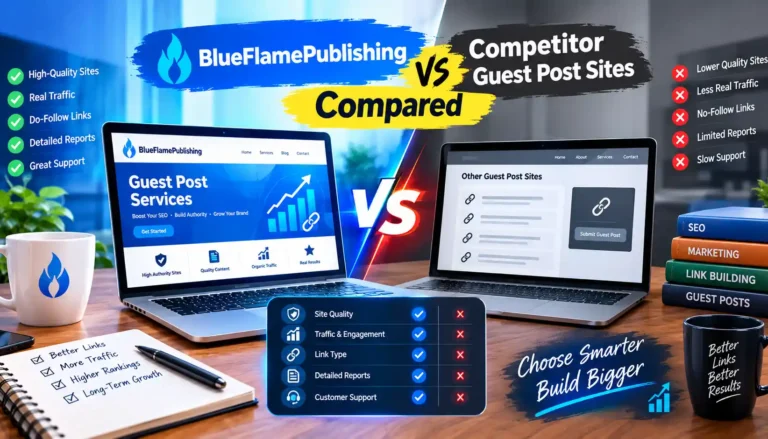
Every link builder has been there. You spot a site that looks like a fit, see a price tag, and wonder whether the placement will help your rankings or just drain your budget. A blueflamepublishing guest post is one of those decisions, and the answer depends on what you know before you pay.
A blueflamepublishing guest post is a sponsored or contributed article on BlueFlamePublishingBlog.com, a general-interest blog. Guest posting remains one of the most accessible ways to earn backlinks, reach new readers and build topical authority. It also attracts hype, and the numbers floating around about this site are easy to misread.
This guide covers what a blueflamepublishing guest post is, how the process works, what you can and can’t expect, and how to protect your investment. You’ll also get a step-by-step plan, tool recommendations and answers to the most common questions.
What Is a Blueflamepublishing Guest Post?
A blueflamepublishing guest post is an article written by an outside contributor, often a marketer, business owner or freelance writer, and published on BlueFlamePublishingBlog.com. In return, the contributor usually gets a contextual link back to their own website.
According to a recent Ranktracker review, BlueFlamePublishingBlog.com is a multi-topic publication covering health, travel, technology, business, writing and general lifestyle subjects. That breadth matters. Niche sites give you tight topical relevance, while a general blog gives you flexibility. A health brand, a travel startup and a SaaS company could all plausibly fit.
Why it matters
For most buyers, the appeal is link equity and visibility. Search engines treat links from other sites as endorsements, so placements on relevant, reputable sites can support rankings. But the value of any single placement depends on the publisher’s quality, audience and editorial standards, not just its price. That is why evaluating a blueflamepublishing guest post carefully matters more than simply buying one.
History and Evolution of the Blueflamepublishing Guest Post
I couldn’t find reliable public documentation of when BlueFlamePublishingBlog.com launched or how it evolved, and I won’t invent a timeline. What can be said is that the site fits a broader pattern.
Guest blogging began as a genuine exchange: bloggers swapped articles to reach each other’s readers. As SEO matured, it became a link-building channel. Marketplaces then emerged that list publishers with set prices, metrics and turnaround times. BlueFlamePublishingBlog.com appears in this marketplace model, and the Ranktracker review notes that the site is also sold as a guest-posting opportunity through Vefogix.
Search engines have also grown more skeptical of paid links. That’s why transparent practices such as proper link attributes, relevant content and real editorial value matter more today than they did a decade ago.
Why Is a Blueflamepublishing Guest Post Important?
Guest posts matter because they combine three things: a backlink, a brand mention and a chance at referral traffic. For small businesses and solo creators, a low-cost placement can be one of the few ways to get content in front of an audience they don’t already own.
The caveat is data. Many people evaluate blogs by traffic estimates, and those can mislead. The Ranktracker analysis makes this point sharply. Its 58.7K monthly traffic figure belongs to Vefogix’s sales page, not BlueFlamePublishingBlog.com itself, so it doesn’t show how many people read the publisher’s own articles. If you’re weighing a blueflamepublishing guest post, remember that a number attached to a marketplace listing is not the same as an audience.
That lesson applies well beyond this one site. Always ask: whose traffic is this, and does it describe the page where my article will live?
How Does a Blueflamepublishing Guest Post Work?
The mechanics are simple.
- Listing: The site is offered through a marketplace. The review reports that the listing charges $64 for an article containing up to two permanent do-follow backlinks.
- Turnaround: The same source says Vefogix estimates a two-day publication time.
- Length: It also says the platform accepts articles between 1,000 and 2,500 words.
Prices, terms and policies change, so confirm everything on the live listing before paying.
A realistic scenario
Imagine you run an online writing course. You commission a 1,500-word article on practical drafting habits and request two links: one to a relevant resource page and one to your homepage. The article goes live in a few days. You then track whether it’s indexed, whether the links are live and followed, and whether any visitors arrive. The placement is a small input into a larger strategy, not a ranking shortcut.
Key Benefits of a Blueflamepublishing Guest Post
When the fundamentals check out, the upsides are real:
- Low entry cost. A listed price of $64 is accessible to small budgets compared with many premium placements.
- Permanent links. Listings advertise permanent, do-follow links, so the placement can keep working without ongoing fees.
- Topical flexibility. A multi-topic site can host content across health, travel, tech, business and lifestyle.
- Speed. A short turnaround helps when you’re testing or running a campaign on a deadline.
- Brand exposure. Even modest readership puts your name in front of new people.
- Content control. In most marketplace arrangements you supply the article, so you control the message and anchor text, within the publisher’s guidelines.
None of these guarantees ranking improvements. They are potential benefits that depend on execution and on the quality of the surrounding site.
Challenges and Common Misconceptions
Misconception 1: “The site gets 58,700 visits a month.” As covered above, that figure describes the marketplace page. The review states plainly that it doesn’t show the publisher receives that traffic, nor that a guest article will receive that traffic.
Misconception 2: “A do-follow link guarantees rankings.” A link is one signal among hundreds. Relevance, placement and the linking site’s own trust all matter.
Misconception 3: “Cheaper is always smarter.” A low price can be a bargain or a warning. Check that the site has real, topical content and isn’t just a link farm.
Challenge: relevance. A general-interest blog can dilute topical signals if your article doesn’t fit the surrounding content. Pitch an angle that makes sense for the site.
Challenge: policy risk. Search engines discourage manipulative paid links. Disclose sponsored content where required and avoid over-optimized anchors.
Solution: Audit the site yourself. Review recent posts, check indexing with a site search, look at outbound-link patterns and judge whether you’d be proud to be published there with no link at all.
Blueflamepublishing Guest Post in 2026: Latest Trends
Link building in 2026 is shaped by a few durable trends:
- Quality over quantity. A handful of relevant placements beat dozens of random ones.
- Transparency about metrics. More reviewers now separate marketplace-page traffic from publisher traffic, as the Ranktracker piece does.
- AI-assisted drafting with human editing. Writers use AI for outlines and research, but editors increasingly reject generic, unedited copy.
- Brand mentions matter. Unlinked mentions and consistent entity signals increasingly complement traditional backlinks.
- Diversified link profiles. Guest posts work best alongside digital PR, original research and internal content marketing.
I can’t responsibly attribute specific predictions to named experts without sources. The consistent direction in industry commentary, though, is that relevance and real value are winning over volume.
How to Implement a Blueflamepublishing Guest Post: Step by Step
- Define your goal. Decide whether you want a backlink, brand exposure or referral traffic. Your goal shapes the article.
- Verify the publisher. Read recent posts, confirm the site is indexed, and check the current listing terms and price.
- Choose a fitting topic. Pick a subject that matches one of the site’s categories (health, travel, technology, business, writing or lifestyle).
- Write for readers first. Aim for 1,000 to 1,500 words of genuinely useful content, comfortably within the listed range.
- Place links naturally. Use up to two contextual links with descriptive, varied anchor text. Link to pages that add value for the reader.
- Submit and confirm terms. Check the guidelines on disclosure, link attributes and edits.
- Verify publication. Once live, confirm the URL, the link attributes and the indexing status.
- Measure results. Track referral visits, ranking movement for the linked pages and any new mentions over 60 to 90 days.
Best Tools and Resources
- Google Search Console (free): Confirms indexing and shows queries and clicks for linked pages.
- Google Analytics 4 (free): Tracks referral traffic from your placement.
- Ranktracker, Ahrefs or Semrush: Backlink and keyword tools for checking site metrics and monitoring your links. Treat their traffic estimates as estimates.
- Grammarly or Hemingway Editor: Quick polish for clarity and tone.
- A simple spreadsheet: Log each placement’s date, cost, URL, anchor text and results.
- Google’s Search Essentials documentation (free): The reference for what search engines consider acceptable link practices.
Case Studies and Success Stories
I couldn’t find any verified, published case studies on results from a blueflamepublishing guest post, and I won’t fabricate one. Here is the most instructive documented example available.
The Ranktracker review is itself a lesson in due diligence. Its authors noticed that an impressive traffic number was tied to a marketplace sales page rather than the publisher, and they flagged the distinction before readers made a purchase decision. The takeaway is a method you can copy: check what a metric measures before trusting it.
If you run your own test, document it. A single placement with before-and-after data on indexing, referral visits and ranking changes is more useful to you than any generic success story.
Expert Tips and Best Practices
- Pitch value, not links. Write an article you’d be happy to see on your own site.
- Match the site’s tone and categories. Relevance protects both reader experience and link value.
- Limit promotional language. One brand mention is plenty.
- Vary anchor text. Over-optimized exact-match anchors can look unnatural.
- Pair placements with other tactics. Combine guest posts with original data, digital PR and strong on-site content.
- Start small. Test one placement, measure it, then decide whether to scale.
- Keep records. Track every link so you can monitor or address problems later.
Frequently Asked Questions
What is a blueflamepublishing guest post?
A blueflamepublishing guest post is an article contributed by an outside writer or brand and published on BlueFlamePublishingBlog.com, usually with a contextual backlink to the contributor’s website. The site is a multi-topic publication covering health, travel, technology, business, writing and lifestyle.
How much does a blueflamepublishing guest post cost?
A recent third-party review cites a marketplace listing price of $64 for an article with up to two permanent do-follow backlinks. Prices and terms change, so confirm the current rate on the live listing before you pay for a blueflamepublishing guest post.
How long does it take to publish a blueflamepublishing guest post?
The marketplace estimate reported in that review is about two days. Actual timing can vary depending on editorial review, revisions and the publisher’s workload.
What word count is accepted for a blueflamepublishing guest post?
The same source reports that articles between 1,000 and 2,500 words are accepted. For most topics, 1,200 to 1,500 words of useful, well-structured content is a safe target.
Does BlueFlamePublishingBlog.com really get 58,700 monthly visitors?
Not according to the available evidence. The 58.7K figure belongs to the marketplace’s sales page, not to the publisher’s own domain. Don’t assume a blueflamepublishing guest post will receive that level of traffic.
Will a blueflamepublishing guest post improve my Google rankings?
It can contribute, but no single link guarantees results. A blueflamepublishing guest post works best when the article is relevant to the site, the anchor text looks natural, and the placement is part of a broader strategy that includes strong on-site content and other quality links.
Is buying a blueflamepublishing guest post safe?
It carries some risk if done manipulatively, since search engines discourage paid links meant to game rankings. To stay on the safe side, write genuinely helpful content, follow disclosure and link-attribute requirements, avoid over-optimized anchors, and track every placement so you can review it later.
Conclusion
A blueflamepublishing guest post can be a reasonable, low-cost way to earn a permanent contextual link and some brand exposure, provided you go in with clear eyes. The site covers a broad mix of topics, and the listing terms look straightforward: a modest price, a quick turnaround and generous word counts. But the traffic figures attached to the listing don’t describe the publisher’s real audience, and no placement is a ranking guarantee.
If you decide to buy, verify the live listing, choose a relevant angle, write something genuinely useful, and measure the outcome. Treat your first blueflamepublishing guest post as a test, learn from the data, and scale only if the results justify it. Smart link building rewards patience, relevance and honest measurement.