You’re looking at a blog on BlueFlamePublishing. The listing says: “DA 45, PA 35.” What does that mean? Should you buy a post from this blog? Most marketers don’t know. They see big numbers and assume they’re good. They buy the post. Then they’re disappointed.
The truth is more complex. BlueFlamePublishing blog DA PA metrics are often misleading. The numbers might be inflated. The quality might be poor. Or the metrics might be real but still not worth buying.
In this guide, you’ll learn what DA and PA actually are. You’ll discover how to verify these metrics. You’ll understand if they matter. And you’ll learn exactly how to decide if a BlueFlamePublishing blog is worth your money.
By the end, you’ll be able to evaluate any blog like an expert. Let’s start.
What is BlueFlamePublishing Blog DA PA?
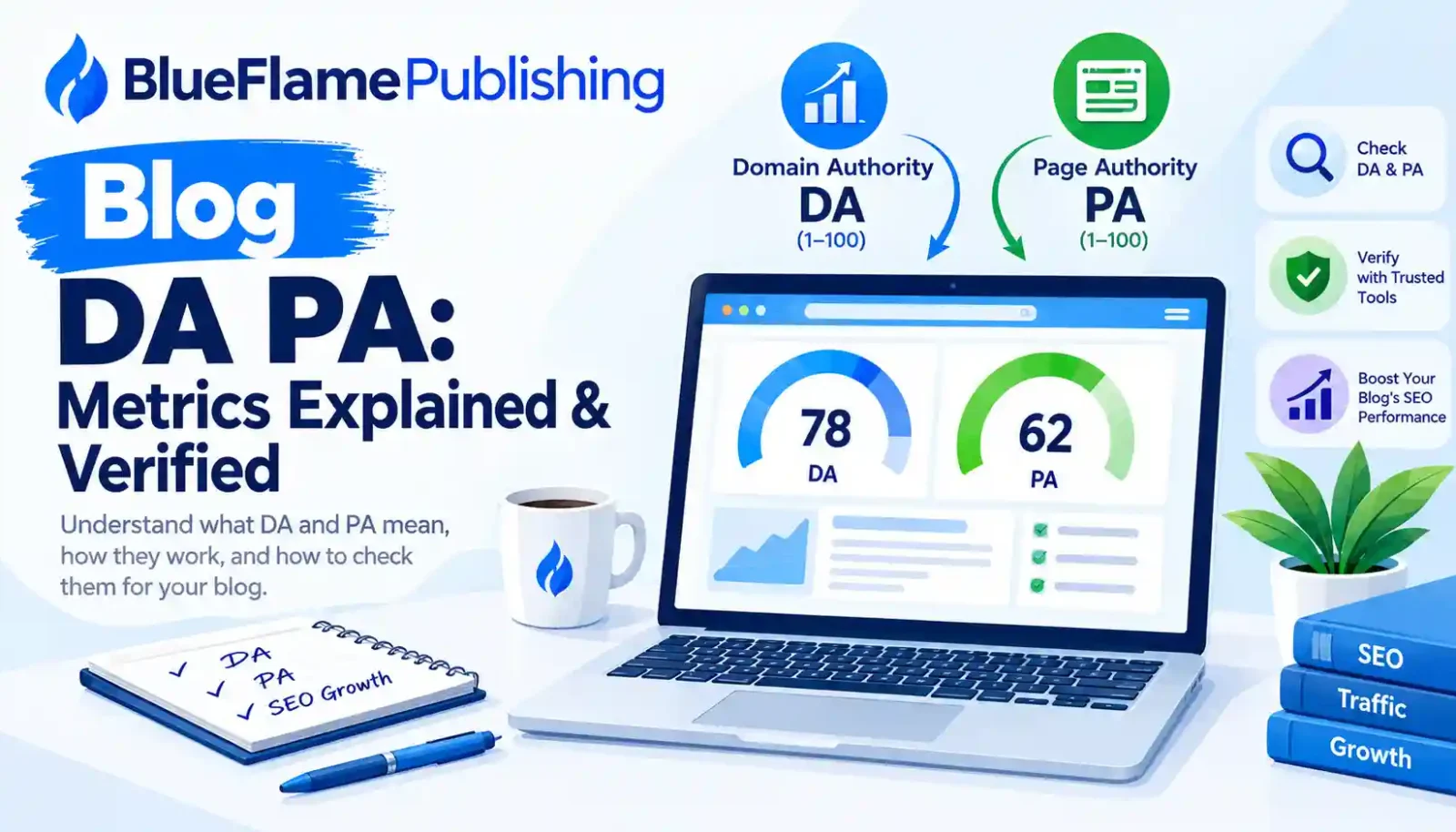
DA stands for Domain Authority. PA stands for Page Authority. Both are metrics created by Moz. They measure how strong a domain or page is for ranking in Google.
Domain Authority (DA):
This measures the entire website’s strength. It’s a score from 1 to 100. Higher numbers mean the site ranks better. A site with DA 50 ranks better than a site with DA 20.
Page Authority (PA):
This measures one specific page’s strength. It’s also 1 to 100. The page where your guest post link appears matters. A higher PA page is better for your backlink.
Why do marketers care?
They think high DA and PA mean the backlink is valuable. They think a link from DA 50 site is worth 5x more than a link from DA 10 site. This makes sense in theory. But in practice, it’s wrong.
BlueFlamePublishing blog DA PA claims can be misleading. They show numbers. But those numbers don’t guarantee quality. This is the core problem.
History & Evolution of BlueFlamePublishing Blog DA PA Metrics
In 2015, Moz created Domain Authority. It was a big innovation. SEOs finally had a metric to compare sites.
Early days (2015-2018):
Marketers trusted DA completely. If a blog said “DA 40,” people believed it. No one questioned it. BlueFlamePublishing used this trust. They showed DA and PA numbers. Marketers bought aggressively. It seemed scientific.
Reality check (2018-2020):
Smart SEOs started investigating. They found the truth: DA alone doesn’t predict link value. A site with DA 50 full of spammy content ranked worse than a DA 30 site with quality content.
The shift (2020-2023):
Google updated their algorithm. They cared less about DA. They cared more about relevance and trust. BlueFlamePublishing didn’t update their pitch. They still showed DA and PA. But these metrics became less meaningful.
Today (2026):
DA and PA are still useful tools. But they’re not the full story. BlueFlamePublishing still uses them as a selling point. Smart marketers know better.
Why is BlueFlamePublishing Blog DA PA Important?
Here’s the honest answer: It’s less important than you think. But it’s still worth understanding.
Why DA and PA matter:
A backlink from a higher DA site usually helps more than a link from a lower DA site. All else being equal, it’s true.
Why they don’t matter as much as marketers think:
Many other factors matter more. Relevance matters. Trust matters. Content quality matters. Link placement matters. A backlink from a DA 20 site in your exact niche beats a DA 50 site in a random niche every time.
The BlueFlamePublishing blog DA PA problem:
BlueFlamePublishing uses DA and PA to attract buyers. They show high numbers. Buyers assume high numbers = quality.
Often, it’s false.
A blog might have DA 45 but be full of spam. A blog might have PA 30 but be placed in the footer (which is worthless).
Statistics:
According to SEMrush data, links from high-DA sites don’t always rank better. 23% of top-ranking sites have backlinks from lower-DA sources. This means DA isn’t everything.
The BlueFlamePublishing blog DA PA metrics alone can’t tell you if a blog is good. You need more information.
How Does BlueFlamePublishing Blog DA PA Work?
How Moz calculates DA:
Moz analyzes millions of websites. They look at how many high-quality sites link to each domain. They create a score based on this. The formula is complex. But the idea is simple: sites with many quality backlinks get high DA.
How Moz calculates PA:
Same concept, but for a single page. They look at links pointing to that specific page. Then they score it.
How BlueFlamePublishing shows it:
When a seller lists a blog, they show the DA and PA. This is pulled from Moz’s public data.
But here’s the issue: Moz updates these metrics every month. Sometimes the numbers change. Sometimes they change a lot. A blog might show DA 45 today. Next month, it could be DA 38. Many sellers don’t update their listings. The numbers become outdated.
Example:
A blog gets hit by Google for spammy links. Their DA drops from 50 to 25 overnight. But BlueFlamePublishing’s listing still says “DA 50.”
You buy a post thinking you’re getting a high-authority site. You’re actually getting a penalized site.
This happens more than you’d think. BlueFlamePublishing blog DA PA numbers are often stale.
Key Benefits of Understanding BlueFlamePublishing Blog DA PA
Make Better Buying Decisions
Once you understand DA and PA, you can evaluate blogs properly. You won’t overpay for inflated numbers.
Avoid Wasted Money
A low-PA page with a good DA site is a waste. You’ll know to skip it.
Spot Red Flags
If a blog claims DA 60 but has terrible design, something’s wrong. You’ll catch the contradiction.
Verify Claims
You won’t trust the seller. You’ll check the metrics yourself with Moz. You’ll know the real truth.
Negotiate Better
If the DA is lower than claimed, you can demand a discount. Or walk away.
Build a Better Backlink Profile
By buying smartly, your links come from higher-quality sources. Your site improves faster.
The biggest benefit: You control the decision. You don’t rely on BlueFlamePublishing’s claims.
Challenges & Common Misconceptions
High DA Always Means Quality
False. A blog with DA 60 can be full of spam. DA measures linking, not quality.
PA is More Important Than DA
Both matter. But the placement and content quality matter more than the PA number.
BlueFlamePublishing Verifies These Metrics
They don’t. They just show Moz’s numbers. Moz data can be inaccurate or outdated.
If DA is High, the Link Will Help My Ranking
Not necessarily. Google doesn’t use DA. Google uses their own algorithm. High DA doesn’t guarantee Google will value the link.
Outdated Metrics
BlueFlamePublishing shows old data. By the time you buy, the metrics may have changed.
Metrics Don’t Show Quality
DA doesn’t measure content quality. A well-written blog with DA 30 beats a poor blog with DA 50.
Hard to Verify
You need Moz’s paid tool to see real metrics. Free tools show limited data.
BlueFlamePublishing Blog DA PA in 2026: Latest Trends & Innovations
Google’s 2024 core update changed everything. High DA doesn’t protect you anymore.
Relevance Over Authority
Google now cares more if the linking site is relevant to your niche. A relevant DA 30 site beats an irrelevant DA 60 site.
E-A-T Signals
Experience, Authority, and Trustworthiness matter more than DA. A trusted expert site with lower DA performs better.
Link Velocity
Google watches how fast you get backlinks. Buying 20 links at once from BlueFlamePublishing looks suspicious. Natural link growth is better.
Content Quality Matters More
The page where your link appears must be high-quality. A high-DA site with poor content around your link doesn’t help.
Expert Prediction:
By 2027, DA and PA will matter even less. Google’s algorithm is moving toward understanding actual trust and relevance. Buying links based on DA alone will become even riskier.
How to Verify BlueFlamePublishing Blog DA PA (Step-by-Step Guide)
Go to Moz Link Explorer
Visit moz.com. Sign in or create a free account. Go to their Domain Analysis tool.
Enter the Blog URL
Type the blog’s web address. Click analyze.
Note the Current DA
You’ll see the real DA number. Compare it to what BlueFlamePublishing claims.
Check the PA of the Specific Page
Go to the page where your link would appear. Check PA for that specific page.
Look at the Spam Score
In the same Moz report, you’ll see spam score. Above 30 is risky. This is critical information.
Check Backlink Quality
Look at who links to the blog. Are they quality sites or spammy directories?
Read the Blog Content
Visit the blog yourself. Read 3-5 posts. Is the writing good? Is it original or copied?
Check Domain Age
Use whois.com. If the domain is brand new but claims DA 50, something’s wrong.
Search for Complaints
Google the blog name + “spam” or “low quality.” See what people say.
Compare to Real Standards
A DA 40 site should have a professional design. It should have thousands of monthly visitors. It should look established. If it doesn’t, the DA is inflated or outdated.
Best Tools & Resources for BlueFlamePublishing Blog DA PA
Moz Link Explorer
Cost: Free (limited) to $99+/month. Shows real DA, PA, and spam score. Essential tool.
Ahrefs
Cost: $99+/month. Shows Domain Rating (similar to DA), backlink quality, and traffic.
SEMrush
Cost: $99+/month. Shows Authority Score and backlink data. Good alternative to Moz.
Ubersuggest
Cost: $12+/month. Shows Domain Score (similar to DA). Budget-friendly option.
Google Search Console
Cost: Free. Shows if a site has manual penalties or is trustworthy to Google.
SimilarWeb
Cost: Free (limited). Shows estimated monthly traffic. Helps verify if DA makes sense.
Moz Learning Center
Free guides on DA, PA, and link building. Learn the concepts deeply.
Google Quality Rater Guidelines
Free PDF from Google. Shows what real quality looks like. Better than DA alone.
Case Studies & Success Stories
The Misleading Metrics
Mark saw a blog on BlueFlamePublishing. It claimed DA 55, PA 42. He bought a post for $300.
When he checked with Moz himself, the real DA was 35. The PA was 18. The listing was lying.
He demanded a refund. BlueFlamePublishing refused. The lesson: Always verify before buying.
The Right Decision
Lisa compared two blogs. Blog A had DA 50, PA 35. Blog B had DA 28, PA 20. Blog A was in a random niche. Blog B was in her exact niche.
She picked Blog B. Six months later, Blog B’s post ranked her keyword to page 1. Blog A did nothing. DA doesn’t beat relevance.
The Quality Surprise
Tom checked a DA 45 blog thoroughly. He used Moz, Ahrefs, and read the content. The blog was truly high-quality. The backlinks were real. The content was excellent. He paid $250 for the post.
That one link helped him rank for his target keyword. He got ROI of 10x. The difference: He did research first.
Expert Tips & Best Practices
Don’t Rely Only on DA
Check DA. But also check spam score, backlink quality, content quality, and relevance.
Verify Before You Pay
Always check with Moz yourself. Never trust the seller’s metrics.
PA Matters More Than DA
The specific page matters more than the overall domain. A high-PA page is better than a high-DA domain with low-PA page.
Relevance Beats Authority
A blog in your exact niche with lower DA beats a random blog with higher DA. Always.
Check the Backlink Anchor Text
Where will your link appear? In the content? In the intro? In the footer? Footer links are worthless.
Look for Natural Links
Does the blog have real backlinks? Or do they all look paid and unnatural? Natural links indicate quality.
Read Recent Posts
Check the last 10 posts. If they’re all thin, poorly written, or copied, the blog is declining. Quality matters more than metrics.
Expert Quote from Rand Fishkin (Moz Founder):
“Domain Authority is a useful tool, but it’s not the be-all and end-all of link value. Relevance, trust, and content quality matter far more.”
Frequently Asked Questions About BlueFlamePublishing Blog DA PA
What’s a Good DA for a Guest Post Blog?
DA 20+ is acceptable. DA 30+ is good. DA 40+ is very good. But relevance matters more than the number itself.
Is PA More Important Than DA?
Yes, actually. The page where your link appears is more important. A high-PA low-DA page beats a low-PA high-DA page.
Can DA Numbers Be Wrong?
Yes. Moz updates monthly. Numbers can be outdated or inaccurate. Always verify with current Moz data.
Should I Avoid Low-DA Blogs?
Not if they’re relevant and high-quality. A DA 15 blog in your niche can be better than a DA 50 random blog.
How Much Should I Pay Based on DA?
Prices should scale with DA, but not too much. A DA 50 blog shouldn’t cost 5x more than a DA 30 blog if quality is similar.
Can I Trust BlueFlamePublishing DA Claims?
No. Always verify with Moz yourself. Their listings are often outdated or inflated.
Does Google Use DA for Ranking?
No. Google doesn’t use Moz’s DA. They use their own metrics. High DA doesn’t guarantee Google will value your link.
Conclusion
BlueFlamePublishing blog DA PA metrics are useful information. But they’re not the whole story. DA and PA measure a site’s authority. They come from Moz. BlueFlamePublishing shows these numbers to attract buyers.
But the numbers can be misleading. They can be outdated. They can be inflated. And they don’t measure quality or relevance. The real decision isn’t just about DA and PA. It’s about relevance, quality, trust, and link placement.
Your action steps:
- Never trust BlueFlamePublishing’s DA and PA claims.
- Check with Moz yourself before buying.
- Look at spam score. Avoid blogs above 30.
- Check if the blog is relevant to your niche.
- Read the actual content. Is it quality?
- Verify the link placement. Will it be in content or footer?
- Compare this blog to alternatives.
BlueFlamePublishing blog DA PA metrics matter. But they’re just one piece of the puzzle. By understanding how they work, you’ll make smarter decisions. You’ll buy from better blogs. Your backlink profile will improve. Your rankings will improve.