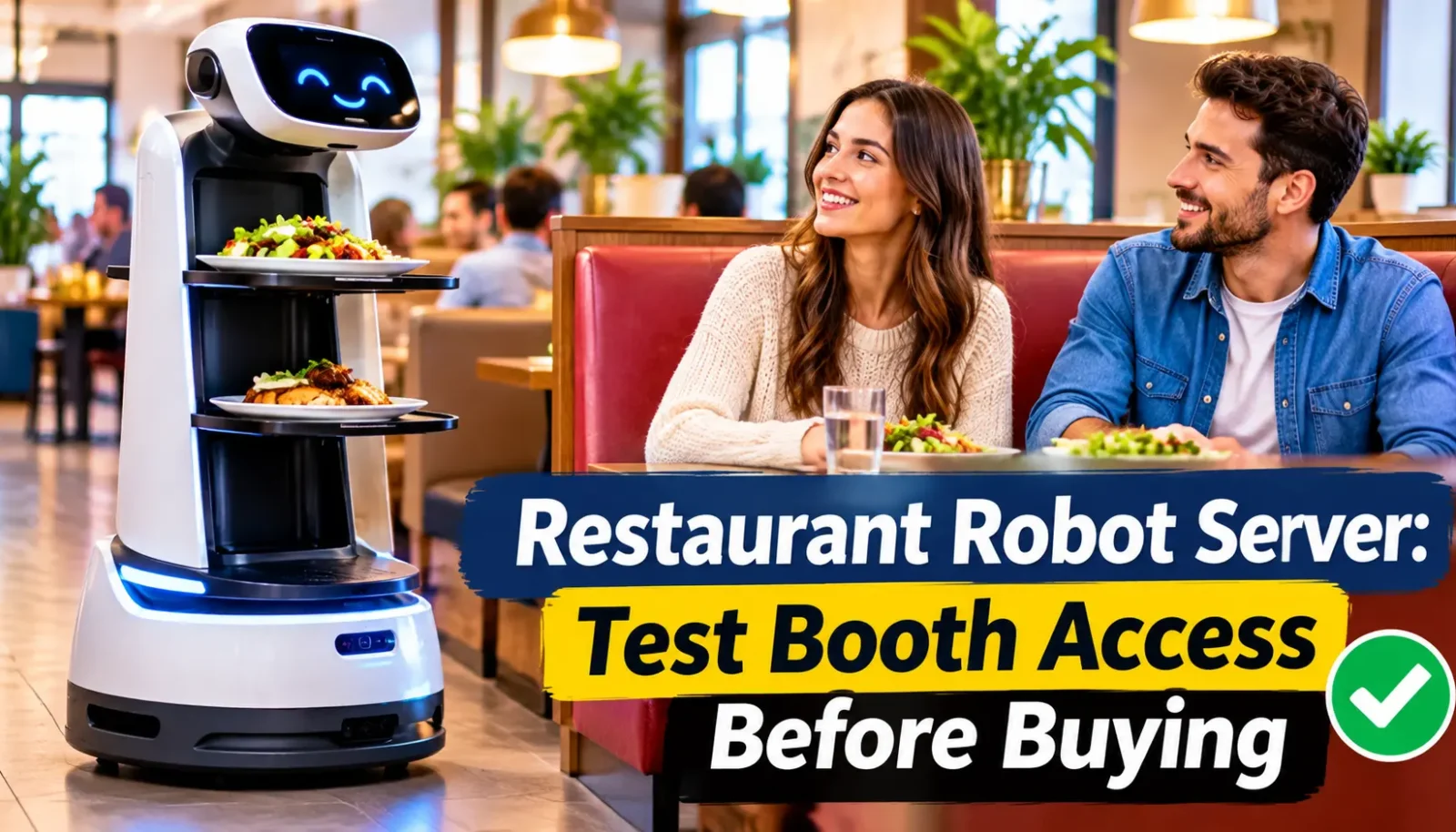
Before Buying a Restaurant Robot Server, Test the Last Few Feet to Your Booths
Restaurant service robots are becoming an interesting option for businesses looking to improve dining room operations and reduce unnecessary staff movement. These machines can carry food from the kitchen to different areas of a restaurant, helping servers manage busy periods more efficiently.
However, there is one important detail restaurant owners should consider before investing in a robot server: Can it actually help deliver food to guests sitting inside a booth?
A robot travelling smoothly through an empty restaurant may look impressive during a demonstration. Real restaurant service is different. Guests move around, chairs take up space, staff carry dishes, and some booth seats are difficult to reach.
The final few feet between the robot and the customer can determine whether the technology genuinely improves service or simply creates another task for employees.
Before purchasing a restaurant delivery robot or changing your dining room furniture, test the complete delivery process. This guide explains what to check, how to evaluate the layout and how to decide whether a robot server is suitable for your restaurant.
Why Restaurant Owners Should Test Robot Servers Before Buying
Restaurant robots are designed to support food transportation and other service tasks. However, their capabilities depend on the machine, restaurant layout and operating conditions.
A robot might travel independently from the kitchen but still require a staff member to collect plates and place them in front of guests.
This is particularly important in restaurants with deep booths, corner seating and tightly arranged dining areas.
Before making a purchasing decision, restaurant owners should understand:
- Whether the robot can navigate the existing dining room.
- Whether it can reach the intended delivery positions.
- How staff will transfer food to customers.
- Whether guests and employees can move around it safely.
- What happens when the robot encounters an obstruction.
- How much additional work the machine creates for employees.
Testing these details helps businesses make a practical investment rather than relying entirely on an impressive product demonstration.
1. Map the Robot’s Route All the Way to the Guest
The first step is to examine the complete route from the kitchen to the customer.
Do not test the robot only in wide, empty aisles. Start with the restaurant booths that are most difficult to serve.
Identify where the robot will stop, where employees will stand and how each plate will reach the guest.
A successful journey through the dining room does not necessarily mean successful food delivery.
For example, a robot may reach the end of a booth but remain too far away from the inside seat. A server may then need to move around the furniture or ask another guest to pass a hot dish.
That is not necessarily an improvement over traditional service.
Use a safe demonstration load and ask employees to complete the delivery process as naturally as possible. If the handoff feels uncomfortable, discuss alternative stopping positions with the supplier.
In some situations, keeping certain booths on the normal server route may be more practical than changing the furniture.
2. Separate Fixed Furniture From Changing Obstacles
Restaurant furniture usually stays in the same position, but the dining environment changes throughout the day.
Guests move chairs, place bags beside seats, stand up to leave and sometimes block aisles while talking. Employees also move between tables carrying orders and clearing dishes.
These everyday activities can affect robot navigation.
During a controlled trial, observe how the machine responds when its usual route becomes unavailable.
Ask the supplier to demonstrate what happens when:
- A guest stands in front of the robot.
- A chair is moved into the aisle.
- A server temporarily blocks the route.
- A bag or other object is left near a booth.
- The machine reaches a narrow corner.
- Its planned stopping position becomes occupied.
Also check whether employees receive clear information when the robot needs assistance.
A successful demonstration should reflect the conditions the restaurant can maintain during normal service, not an artificially cleared dining room.
3. Solve the Reach Problem at the Inside Booth Seat
One of the biggest challenges with restaurant delivery robots is reaching guests seated inside deep booths.
The machine may arrive beside the table, but the person sitting against the wall could still be difficult to serve.
This creates an important question: Who completes the final food delivery?
Before purchasing a robot server, evaluate every seating position and agree on a practical handoff procedure.
Consider these points:
- Test delivery to both outside and inside booth seats.
- Check whether nearby chairs interfere with the robot’s stopping position.
- Make sure employees can approach the table comfortably.
- Avoid expecting guests to pass hot plates between themselves.
- Keep a server available for deep booths and larger U-shaped seating sections.
A robot should support employees rather than create an uncomfortable experience for customers.
If a particular booth cannot be served effectively, consider an alternative delivery point or retain conventional service for that area.
4. Check Restaurant Aisle Width and Guest Accessibility
Restaurant robots must share space with customers, servers and other people moving through the dining room.
This makes aisle accessibility an important part of the planning process.
A route that looks wide enough when every chair is tucked under a table may become much narrower during a busy meal service.
Restaurant owners should examine the layout with occupied seating and normal staff activity.
Pay particular attention to:
Clear passage space: Check whether guests and employees can move comfortably when the robot is travelling or waiting.
Turning areas: Some dining room corners may not provide enough room for a particular robot to turn.
Exit routes: Make sure the machine does not obstruct required exits or circulation paths.
Mobility access: Consider guests using wheelchairs, walking aids or other mobility equipment.
Floor conditions: Check thresholds, floor transitions, rugs and uneven surfaces against the manufacturer’s operating requirements.
The US Access Board provides guidance on floor and ground surfaces. These accessibility guidelines should not be confused with a robot’s technical operating requirements. Both need to be considered separately.
A restaurant should never depend on guests moving out of the way simply to allow a delivery robot to complete its journey.
5. Measure the Actual Work the Robot Can Save
A robot travelling quickly does not automatically mean restaurant employees are saving time.
The machine may transport dishes across the dining room independently, but employees could still spend considerable time loading, unloading and completing deliveries.
To understand its real value, compare the existing service routine with the proposed robot-assisted process.
For example, consider a restaurant with several deep booths.
The first option is to let the robot travel directly to each booth. The second is to have it carry food from the kitchen to a designated collection point, where a server completes the final delivery.
Both approaches should be tested using comparable orders and destinations.
Record:
- Total delivery time.
- Employee time spent handling the order.
- Waiting time at the booth.
- Number of successful deliveries.
- Trips requiring staff intervention.
- Additional handling or sorting time.
Keep waiting time separate from employee working time. A robot may travel independently while a server remains occupied waiting for the machine.
The results will help determine whether direct table delivery or a limited transport role offers greater practical value.
6. Design a Clear Handoff Between the Robot and Server
A successful restaurant robot system needs a clear handoff procedure.
Employees should know when an order is ready, where the robot will stop and who is responsible for completing the delivery.
This is particularly important when one robot carries dishes for multiple tables.
Before starting a trial, demonstrate how the team will:
- Load the correct dishes.
- Organise orders by destination.
- Send the robot along its assigned route.
- Identify the correct receiving employee.
- Complete the final delivery.
- Confirm that the order has been delivered correctly.
The procedure should also cover special requests and order changes.
For example, if a server becomes unavailable just before the robot reaches a booth, employees should know who will receive the alert and where the food will wait.
A well-organised handoff prevents unnecessary confusion and makes robot-assisted service easier to manage.
7. Plan for Charging, Parking and Unexpected Stops
Restaurant owners sometimes focus so much on navigation that they forget about what happens when the robot is not delivering food.
Every machine needs an appropriate place to wait, charge and undergo routine cleaning.
These requirements should be included in the restaurant layout review.
Consider the following questions:
- Where will the robot park between deliveries?
- Is there a suitable charging location?
- Can staff clean the machine easily?
- What happens if it stops in a narrow aisle?
- Who is responsible for recovering it?
- Can normal restaurant service continue during a system outage?
Employees should practise the usual service routine with the robot temporarily unavailable.
This ensures that the dining room can continue operating without depending entirely on the machine.
When reviewing supplier quotations, include the cost of training, charging arrangements, maintenance, technical support and any necessary furniture changes.
The final decision should be based on the complete operating cost rather than the purchase price alone.
8. Test the Complete Delivery Process Before Making a Decision
The final demonstration should involve the restaurant’s actual service team and the seating areas that create the most difficulty.
Ask employees to carry out the entire routine without continuous assistance from the salesperson.
Observe whether the robot can:
- Travel from the kitchen to the intended destination.
- Navigate around occupied seating.
- Stop in an appropriate position.
- Allow employees to collect the dishes comfortably.
- Support delivery to inside booth seats.
- Recover from an interrupted journey.
- Return to its designated waiting or charging area.
The demonstration should also include a realistic handoff using the restaurant’s normal order procedures.
If the process only works after moving furniture or removing occupied chairs, the results may not reflect everyday restaurant conditions.
A proper trial gives owners a clearer picture of what the machine can realistically accomplish.
Benefits of Choosing the Right Restaurant Robot Server
When the technology fits the restaurant’s layout and service routine, a delivery robot may offer several practical advantages.
Reduced Food Transportation Work
Robots can help transport dishes between the kitchen and designated collection points, potentially reducing some repetitive walking for employees.
Support During Busy Service Periods
A suitable machine may help staff manage food transportation while they focus on customer interaction and other responsibilities.
More Consistent Delivery Routes
Automated navigation can provide a repeatable transportation route when the restaurant environment supports reliable operation.
Better Workflow Planning
Testing the complete process can help restaurant owners identify where automation adds value and where human service remains essential.
However, these benefits depend on the robot model, operating conditions and quality of the handoff process.
Frequently Asked Questions
1. Can restaurant delivery robots serve customers sitting in booths?
Some robots can deliver food close to booth seating, but reaching guests in deep or enclosed booths may require a server to complete the final handoff. The process should be tested before purchasing the machine.
2. What should I check before buying a restaurant robot server?
Check navigation, aisle clearance, booth accessibility, stopping positions, food handoff procedures, charging requirements, maintenance and staff training.
3. Do restaurant robots require special furniture?
Not always. Some robots can operate with existing restaurant furniture. However, certain layouts may require alternative stopping points or adjustments to improve accessibility and circulation.
4. Are restaurant delivery robots safe around customers?
Safety depends on the specific machine, its sensors, operating environment and staff procedures. Follow the manufacturer’s instructions and assess the restaurant’s circulation and accessibility requirements before introducing a robot.
5. Can a restaurant robot replace human servers?
Restaurant delivery robots are generally better viewed as support tools. Human employees remain important for customer communication, order accuracy, food handling and completing deliveries that the machine cannot manage independently.
6. How can I measure whether a restaurant robot is worthwhile?
Compare the complete delivery process with and without the robot. Measure employee working time, delivery time, waiting time, failed journeys and additional handling. Also consider purchasing, training and maintenance costs.
Final Thoughts
Buying a restaurant robot server is not simply about choosing a machine that can move food from the kitchen to the dining room. The real challenge is making sure the technology works with the restaurant’s existing furniture, staff routines and customer needs.
Deep booths, narrow aisles and inside seating positions can create practical problems that are easy to overlook during a product demonstration.
Before investing, test the complete delivery journey, including the final handoff to the guest. Give employees an opportunity to operate the machine, examine difficult seating areas and practise what happens when a delivery is interrupted.
In some restaurants, direct table delivery may work well. In others, using a robot to transport dishes to a staffed collection point may be the better solution.
The most successful approach is the one that makes service more practical without making the dining experience less comfortable.
Ultimately, the last few feet still matter. A robot can handle transportation, but a thoughtful human handoff helps ensure that every guest receives their meal properly.